Powering Outdoor Events: A Complete Guide to Event Generators
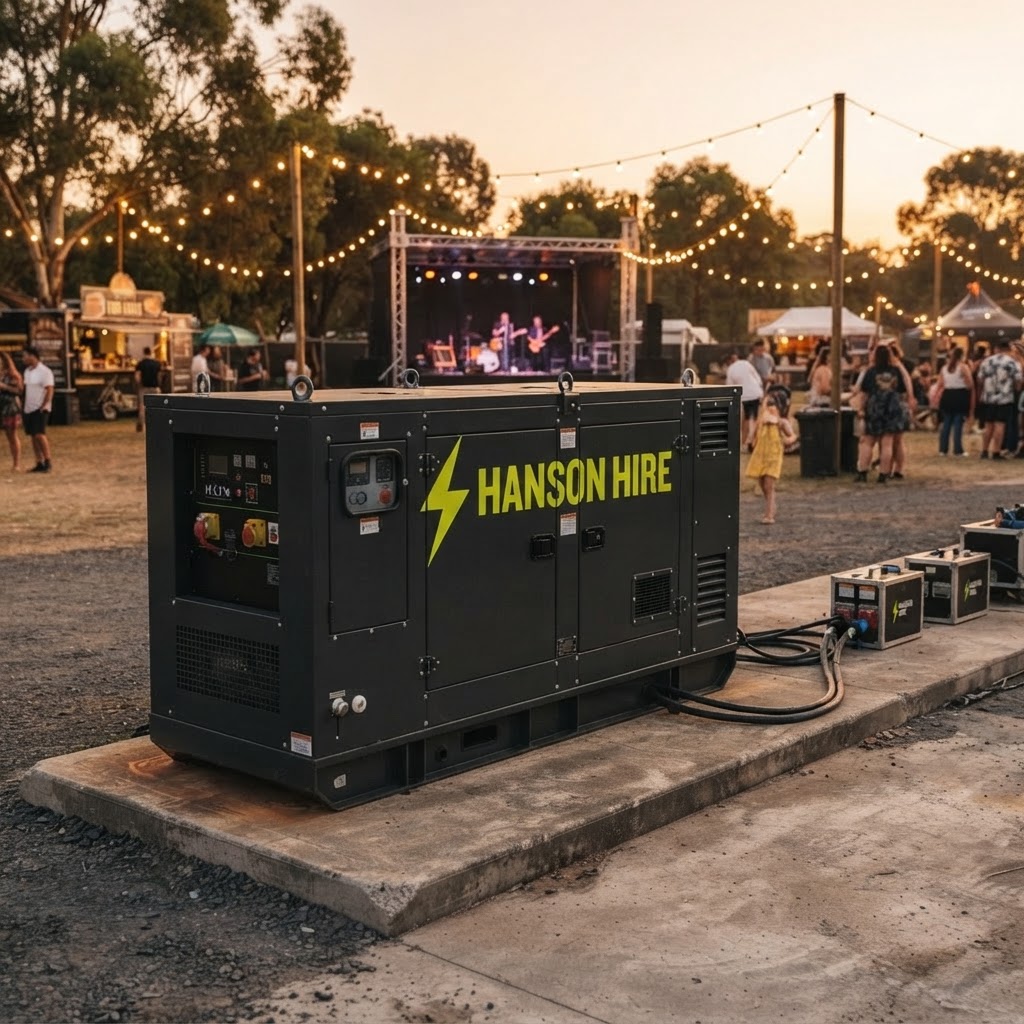
From food trucks to stage lighting, outdoor events need clean, quiet, reliable power. Here is how to choose the right generator for your event.
By Hanson Hire
Quick Answer
For outdoor events, choose a silenced diesel generator rated at least 30% above your total power demand. Position it at least 20 metres from audiences, use distro boxes for cable management, and always have a backup generator for critical loads like stage audio and refrigeration.
Understanding Event Power Needs
Outdoor events have unique power requirements. Unlike construction sites, events demand clean, stable power — a voltage spike can destroy audio equipment, and a power failure can ruin a entire festival.
Step 1: Audit Your Power Load
List every item that needs power:
- Audio and PA systems: 2-10 kW depending on scale
- Lighting: 1-5 kW per lighting rig
- Food vendors: 3-15 kW per food truck or stall
- Refrigeration: 1-3 kW per commercial fridge
- Ticketing and Wi-Fi: 1-2 kW
- Site lighting and amenities: 2-5 kW
Step 2: Choose a Silenced Generator
For events, noise matters. Standard construction generators run at 75-85 dB at 7 metres — far too loud for audiences.
Look for generators with:
- Canopy attenuation: soundproofed enclosures reducing noise to 60-70 dB
- Super-silenced models: as low as 55 dB at 7 metres
- Dual frequency: 50 Hz output with clean sine wave for sensitive electronics
Step 3: Size for Headroom
Events are unpredictable. Vendors arrive late, extra equipment gets plugged in, and startup surges are common. Size your generator at least 30% above your calculated peak demand.
| Event size | Recommended generator | | --- | --- | | Small (market, single stage) | 20-40 kVA | | Medium (festival, multiple vendors) | 60-100 kVA | | Large (multi-stage festival) | 150-250 kVA+ |
Step 4: Cable Management and Distribution
Never run long cable runs directly from the generator. Use:
- Distro boxes: distribute power safely to multiple circuits
- Armoured cables: for ground runs across walkways
- RCD protection: mandatory for all outdoor circuits
- Cable ramps: protect cables and prevent trip hazards
Step 5: Positioning
Place generators:
- At least 20 metres from audience areas
- Downwind of the event (consider prevailing wind)
- On stable, level ground
- Accessible for refuelling without crossing crowd areas
Have a Backup Plan
For critical loads (refrigeration, medical, stage audio), always have a secondary generator on standby with an automatic transfer switch (ATS). If the primary fails, the backup takes over within seconds.
Fuel Planning
A generator running at 75% load consumes roughly 0.3 litres per kVA per hour. A 100 kVA generator at full load uses about 30 litres/hour. Plan refuelling schedules accordingly and always keep a minimum of 24 hours of fuel on site.
Need Power for Your Event?
Get a quote or contact our team — we deliver, set up, and support silenced event generators across Melbourne and Victoria.
Frequently Asked Questions
Common Questions
Shop generators for sale
Browse our full range of diesel and petrol generators for sale, with delivery across Melbourne and Victoria.
Browse the storeWritten by
Hanson Hire
Melbourne's trusted generator hire, sales and complete power services. ABN 56 684 753 875.
Learn more about usNeed a generator for your site?
Get an instant quote or talk to our team about your power requirements.